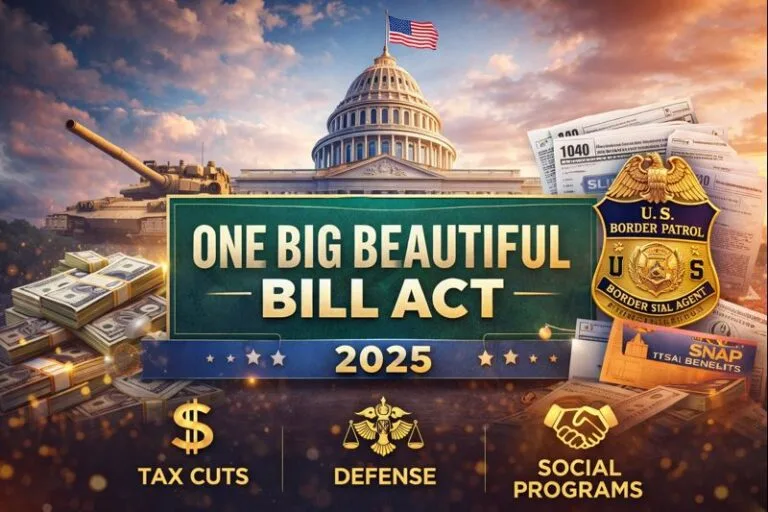
The One Big Beautiful Bill Act (often abbreviated OBBBA) is a sweeping U.S. federal law passed during the 119th Congress that reshapes major tax, spending, and federal program policy as part of a broad reconciliation package. It reflects one of the most significant pieces of legislation enacted in 2025 with extensive effects on taxation, social welfare, defense, immigration enforcement, and more.
📌 What Is the One Big Beautiful Bill Act?
The One Big Beautiful Bill Act (H.R. 1) was approved by Congress and signed into law by President Donald Trump on July 4, 2025. While popularly known by its nickname, the bill’s official short title was removed during the legislative process; nevertheless, the name remains widely used in media and policy analysis.
The legislation was enacted through the budget reconciliation process, a special procedure that allows certain budget‑related bills to pass with a simple Senate majority.
🧾 Key Provisions of the One Big Beautiful Bill Act
The OBBBA includes hundreds of tax and spending provisions across multiple policy domains. Below is an overview of the most impactful elements:
1. 📉 Major Tax Code Changes
- Permanent extension of many tax cuts from the 2017 Tax Cuts and Jobs Act (TCJA) that were set to expire in 2025.
- Expanded individual tax deductions, including for tips, overtime income, and auto loans.
- Increased cap on the state and local tax (SALT) deduction to $40,000 for eligible taxpayers, though it later reverts after a few years.
- Enhanced child tax credit a permanent increase to support families.
- New mechanisms such as tax incentives for parents’ savings accounts.
These tax provisions broadly benefit corporations, higher‑income households, and many small businesses while offering some relief for middle‑income taxpayers.
2. ⚖️ Spending Cuts and Welfare Changes
The Act also makes significant reductions to major social programs:
- Cuts to federal Medicaid spending, including stricter work and eligibility requirements.
- Changes to food assistance (SNAP) work requirements and cost‑sharing with states.
These provisions are controversial: while proponents argue they reduce waste and incentivize work, critics worry they will reduce coverage and assistance for vulnerable populations.
3. 🛡️ Defense and Enforcement
The law allocates hundreds of billions more for national defense and border enforcement:
- Increased funding for the Department of Defense and military modernization.
- Substantially expanded budgets for Immigration and Customs Enforcement (ICE) and border security operations.
- Additional funding for customs and immigration agencies over the next several years.
4. 📊 Economic and Fiscal Impact
According to estimates from the Congressional Budget Office (CBO) and other nonpartisan sources:
- The bill may add trillions to the national debt over the next decade due to tax cuts outpacing revenue changes.
- Some analyses project an increase in the federal deficit exceeding $2.5–$3 trillion.
These projections have intensified debates about long‑term fiscal sustainability.
5. 🌍 Energy and Environmental Policy
The OBBBA also reshapes energy policy by:
- Eliminating certain clean energy incentives, such as tax credits for wind and solar projects created under prior legislation.
- Promoting increased access and tax support for fossil fuel production.
This shift realigns federal energy priorities and has drawn criticism from environmental advocates.
📊 Support, Opposition, and Public Debate
The One Big Beautiful Bill Act is one of the most controversial pieces of recent U.S. legislation. Here’s how opinions break down:
👍 Supporters Argue
- It keeps taxes low and permanently extends tax relief.
- It strengthens the economy by supporting small business investment.
- Defense and enforcement funding will enhance national security.
👎 Critics Claim
- It cuts essential safety net programs like Medicaid and food assistance.
- It increases the federal deficit significantly.
- Many worry that the tax benefits disproportionately favor wealthier individuals and corporations. Analysts have called it the largest wealth transfer upward in decades.
🗳️ Why It Matters in 2026
As the Act continues to take effect in 2026:
- Tax returns for 2025 filing season reflect many of the OBBBA changes.
- Refunds for many taxpayers are expected to be larger due to extended tax cuts but spending cuts to safety net programs are drawing public concern.
- State governments and social services are grappling with new eligibility and cost‑sharing requirements.
📌 Summary
The One Big Beautiful Bill Act is a landmark legislative package with far‑reaching effects on U.S. tax policy, social safety programs, defense funding, and budget deficits. It reflects major policy priorities while sparking deep debate over government spending, social welfare, and economic equity in the United States.
Frequently Asked Questions (FAQs)
1. What is the One Big Beautiful Bill Act?
It is a major 2025 U.S. federal law (H.R. 1) that restructured taxes, federal spending, and public program funding under the budget reconciliation process.
2. When did the Act become law?
The bill was signed into law on July 4, 2025, by President Donald Trump.
3. How does it affect taxes?
It permanently extends many tax cuts, increases the SALT deduction cap, and adds new individual tax relief measures.
4. Does it reduce social programs?
Yes the Act cuts or changes Medicaid and SNAP eligibility and benefits, which has been a source of controversy.
5. Why do critics oppose it?
Critics argue it increases the deficit and shifts benefits toward wealthy individuals and corporations.
Reference Links
- One Big Beautiful Bill Act full summary — Wikipedia
https://en.wikipedia.org/wiki/One_Big_Beautiful_Bill_Act - Detailed provisions and tax changes — USAFacts
https://usafacts.org/articles/whats-in-the-one-big-beautiful-bill/ - White House overview and myth vs fact
https://www.whitehouse.gov/obbb