
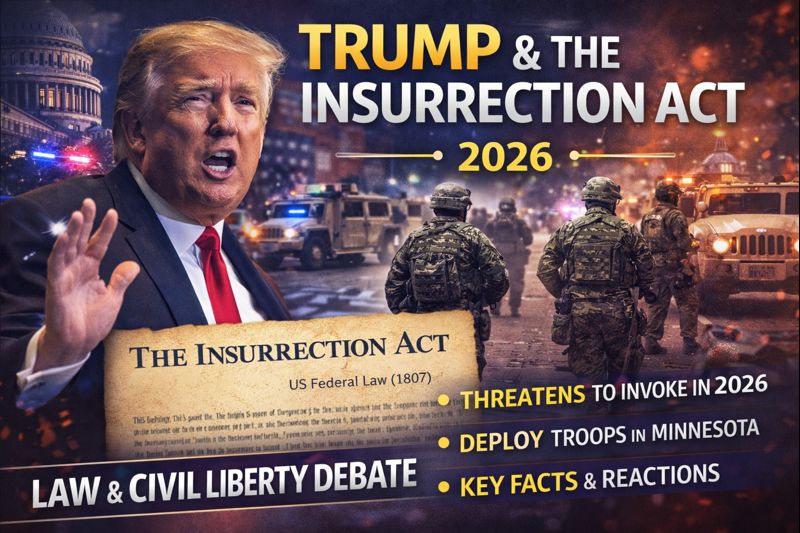
In January 2026, former U.S. President Donald Trump made headlines when he threatened to use the Insurrection Act, a federal law from 1807 that lets a president send the U.S. military into action at home under certain conditions. This threat came while protests were going on in Minneapolis, Minnesota, because of controversial federal immigration enforcement actions and shootings involving Immigration and Customs Enforcement (ICE) agents.
Trump’s comments have sparked a lot of debate about the powers of the president, civil liberties, and the balance of power between the federal and state governments, especially when it comes to putting troops on U.S. soil.
What Is the Insurrection Act?
The Insurrection Act is a federal law that was passed in 1807. It gives the president the power to send troops into the U.S. in certain situations, such as:
- to put down uprisings or rebellions
- to make sure that federal laws are followed when local governments can’t or won’t do so
- to protect civil rights in unusual situations
The Posse Comitatus Act usually stops the U.S. military from helping with civilian law enforcement. When “unlawful obstruction” makes it impossible to enforce the law, the Insurrection Act is a legal exception to that rule.
From Abraham Lincoln during the Civil War to George H.W. Bush in 1992, presidents have used the law in major domestic crises. However, this has not happened very often in recent years.
Why Trump Threatened to Use It (Minnesota Context)
In early 2026, there were protests in Minneapolis, Minnesota, after protesters and federal immigration agents clashed several times. These protests were connected to:
- an ICE agent shot someone to death
- a second shooting of a man during a federal law enforcement operation
Trump called the unrest a failure by state leaders to keep order and told them to do something about it. He also said that if necessary, he could use the Insurrection Act to send in troops.
He made these threats on social media and in public statements, saying that he would use the Act if local politicians didn’t “obey the law” and stop “agitators” from attacking federal workers.
What the Law Actually Allows
If the Insurrection Act were officially used, the president could:
- Send National Guard units to work with active-duty military personnel and make them federal.
- Allow federal troops to help or take the place of civilian law enforcement
- Temporarily override the Posse Comitatus Act
The law does not give police unlimited power; it is only meant to be used in very serious situations when local police can’t handle it.
Reactions: Political, Legal & Public Response
People who support the threat say:
- The federal government is allowed to protect its own officers and property.
- State leaders’ refusal to stop unrest calls for federal action.
Critics counter that:
- Using the Act is not right because protests are not uprisings.
- Whoopi Goldberg said on The View that protesting is not an insurrection and criticized how it was framed.
- Sending troops to fight in the U.S. could hurt civil rights.
Many civil liberties groups and Democrats have spoken out against the rhetoric, saying that real uprisings are rare and that peaceful protests shouldn’t lead to military deployment.
Has the Insurrection Act Been Used Recently?
Trump has not officially used the law as of January 2026, even though he said he would. Before modern invocations, there were:
- Riots in Los Angeles in 1992 (George H.W. Bush)
- Enforcement of civil rights in the 1950s and 1960s
Threats to use it without a formal invocation can still have an effect on the relationship between the federal government and the states and on legal cases.
Frequently Asked Questions (FAQs)
Q1: What is the Insurrection Act, really?
The 1807 U.S. federal law lets the president send troops into the country to put down uprisings, enforce federal laws, or restore order when civil authority isn’t enough.
Q2: Why did Trump say he would use it in 2026?
Trump made the threat while protests were growing in Minneapolis because of federal immigration enforcement actions. He said that local leaders had not done enough to keep the peace.
Q3: Does using the Insurrection Act mean putting martial law in place?
Not always. It is a legal way to send in troops. Martial law, on the other hand, is when civilian legal protections are put on hold and has stricter constitutional requirements.
Q4: Has it ever been used before?
Yes, but only a few times, like during the Civil Rights Movement and the Los Angeles riots in 1992.
Q5: What are the risks of using the Insurrection Act?
Legal problems, political backlash, and worries about civil liberties are all big risks. Using troops against civilians can make things worse and raise questions about the Constitution.
Reference Links
Here are trusted sources for more detailed reporting on this topic:
- Trump Threatens to Use Insurrection Act in Minnesota — Reuters
https://www.reuters.com/world/us/trump-threatens-use-insurrection-act-minnesota-2026-01-15/ - Explaining the Insurrection Act’s Powers & Limits — PBS NewsHour
https://www.pbs.org/newshour/show/what-is-the-insurrection-act-explaining-its-powers-as-trump-threatens-to-use-it - Trump Threatens Deploying Troops After Minnesota Protests — Time
https://time.com/7346519/trump-threatens-insurrection-act-deploy-troops-minnesota/ - Criticism from Public Figures on Act Use — Decider (The View)
https://decider.com/2026/01/15/the-view-whoopi-goldberg-trump-insurrection-act/ - AP News — Trump Insurrection Act Threat Story
https://apnews.com/article/a0c368079c106b599245996fded8c1b9