
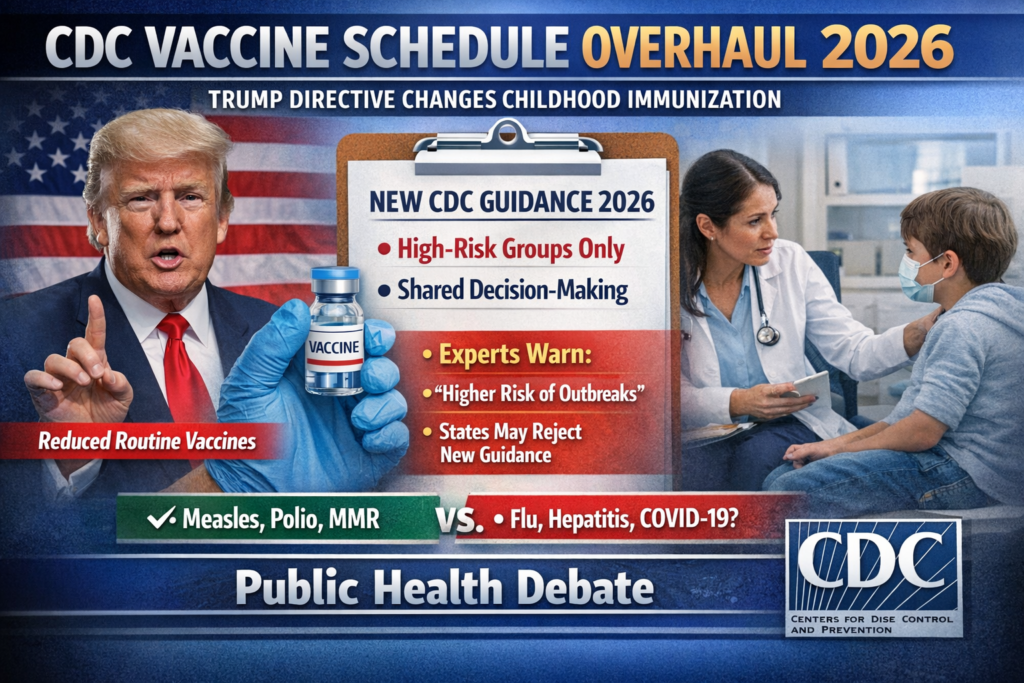
The Centers for Disease Control and Prevention (CDC Vaccine) released a new schedule for childhood vaccinations in January 2026. This was done as part of an order that started during President Donald Trump’s time in office. The update cut down on the number of vaccines that are recommended for all children and moved some to shared clinical decision-making or high-risk-only recommendations.
The change has sparked a nationwide debate among public health experts, pediatricians, policymakers, and parents. It is one of the most important changes to U.S. vaccine policy in decades.
What Changed in the CDC Vaccine Schedule?
With the new guidance:
- The number of vaccines that are recommended for all children was cut down.
- There are now a number of vaccines that are mostly recommended for:
- Kids at high risk, or
- Use after parents and healthcare providers have talked about it and made a decision together.
Vaccines that were affected are:
- The flu
- Rotavirus
- Hepatitis A and B RSV
- Some meningococcal vaccines
- COVID-19 (regular doses for kids at low risk)
Vaccines like MMR (measles, mumps, rubella), polio, DTaP, varicella, pneumococcal, and HPV are still widely recommended.
Why Were These Changes Made?
After a federal review request to compare the U.S. vaccine schedule with those of other developed countries, the revision was made. The Trump administration said that the U.S. schedule had too many routine vaccinations and stressed the importance of parental choice and openness.
The Department of Health and Human Services (HHS) oversaw the review, and leaders who were against vaccine policy backed it. However, officials said that:
- Access to vaccines stays the same.
- There is no change in insurance coverage.
- There were no bans or withdrawals of vaccines
Reaction From Medical Experts and Public Health Groups
People who support say:
- The changes give parents more power.
- Promote informed consent
- Make the U.S. more like other countries in the world
Critics Say:
- Lowering routine recommendations may lead to fewer vaccinations.
- Higher chance of outbreaks of diseases that can be avoided
- Political influence may have superseded established scientific protocols.
Many big medical groups, such as those for children and infectious diseases, have said publicly that they are worried about the long-term effects on public health.
What This Means for Parents and Healthcare Providers
Parents may now see:
- More talks with pediatricians before getting some vaccines
- Differences between states and health systems
- Still being able to get all vaccines, but with different levels of recommendation
Healthcare providers should:
- Make a clinical decision
- Write down the shared decision-making.
- Keep giving vaccines based on each person’s risk.
Some states and healthcare systems in the U.S. have said they might keep following CDC schedules from the past.
Frequently Asked Questions (FAQs)
Did Trump take vaccines off the CDC schedule?
No. Vaccines were not taken away or banned. Some were moved from “universally recommended” to “shared decision-making” or “high-risk only.”
Are kids in the U.S. still able to get vaccines?
Yes. Healthcare providers and federal programs still offer all vaccines, and they are still approved.
Does this mean that vaccines are not safe?
No. The CDC did not say that any vaccine was unsafe. The changes have to do with recommendation categories, not safety findings.
Will vaccines still be covered by insurance?
HHS says that insurance coverage, including programs like Vaccines for Children (VFC), should continue, but how it is implemented may differ from one provider to the next.
Should parents still get their kids vaccinated?
Parents should talk to licensed healthcare providers about vaccination choices, especially for vaccines that are now part of shared decision-making.
Is it possible for states to ignore the new CDC schedule?
Yes. States, school systems, and health networks can make their own rules about vaccinations and may keep following the advice they got before.
Will this change last?
Not always. Every year, the CDC looks over its immunization schedules and may change them again based on new scientific evidence or new administrations.
Why This Update Matters
The CDC vaccine schedule has long been seen as the best way to protect people in the U.S. This change is part of a bigger trend in how federal public health advice is made, where science, politics, and personal choice are more clearly mixed than they were in the past.
Experts in public health say that it may take years to fully understand the effects.
References
- CDC Immunization Schedules (Official)
https://www.cdc.gov/vaccines/hcp/imz-schedules/index.html - HHS Press Release on Schedule Update (Jan 2026)
https://www.hhs.gov/press-room/cdc-acts-presidential-memorandum-update-childhood-immunization-schedule.html - AP News – CDC Reduces Routine Childhood Vaccines
https://apnews.com/article/9b8df9e2767c1261aaac4e2331e77fa3 - NBC News – What Changed in the CDC Vaccine Schedule
https://www.nbcnewyork.com/news/health/childhood-vaccine-schedule-changes/6439628/ - Washington Post – Vaccine Schedule Overhaul Analysis
https://www.washingtonpost.com/health/2026/01/05/childhood-vaccine-immunization-schedule-overhaul/ - Al Jazeera – Global Reaction to U.S. Vaccine Policy Shift
https://www.aljazeera.com/news/2026/1/6/alarms-raised-as-trumps-cdc-cuts-number-of-suggested-vaccines-for-children - FactCheck.org – Trump Claims on Vaccine Schedules
https://www.factcheck.org